What We Do for AI
SoftIron unlocks an edge-first public cloud that rewrites the rules on your terms, in your environment.
At its core, artificial intelligence (AI) is driven by models and workloads running on acceleration resources such as graphics processing units (GPUs). SingularIT™ supports AI workloads by providing a transparent fabric of resources with minimal operational overhead. It comes online quickly, works immediately, and continuously supplies the full range of required resources without bottlenecks or redesign as your organization scales. Networking, storage for models and outputs, and GPU compute power all scale freely, without operational intervention; pre-, post-, and co-processing become routine.
This cloud-like experience also supports multiple models, users, and workloads sharing processor and GPU resources, scaling from a standalone deployment to regional data-center scale without modifying the architecture. The only difference between the smallest deployment and the largest is resource size.
Highlights:
-
Turn-key in hours. Set up is easy, delivered as an edge-first public cloud experience. Install workloads from our cloud app store and start using them immediately.
-
Built for an evolving AI journey. Expand, run models in parallel, support multiple models, and compare software stacks or acceleration platforms as needs change.
-
Silicon-agnostic by design. Use any type of acceleration—side by side, across tenancies, and on your terms—because all resources are transparently virtualized.
-
Any model to any silicon. Map algorithms to the best-fit hardware, in parallel, with resource sharing and strong isolation, within or across tenancies.
-
Scale without redesign. Add resources incrementally or in bulk, without architectural changes.
-
No integration tax. AI resources are shared and provided transparently, without care-and-feeding overhead.
-
Offline operation. Run AI workloads without internet connectivity.
-
IP stays local. Models, tools, code, training data, inputs, and outputs remain yours, without exposure or leakage.
-
True tenancies and GPU sharing. Reuse acceleration assets efficiently across the organization.
-
Cost efficiency. Often ~1/10th the cost of conventional public cloud.
-
No usage-based billing for on-prem deployments. Full utilization 24/7 is expected and supported.
-
Expandable to regional scale and beyond. Grow without limit, then federate across sites.
-
Very low latency. Everything is local and native: fast interactions, versioning without penalty, and improved security without complicated, finops-driven constraints.
Start your AI journey here and keep scaling without limits. We focus on resource virtualization so infrastructure stays out of the way, from experimentation through production. AI technology moves fast; we make sure the platform keeps up.
Storage 2.0
SingularIT™ allows physical storage (i.e., media of any kind) to be virtualized away from physical devices. All storage resources are federated into a whole and virtualized and abstracted from the underlying physical devices.
Supported scale ranges from very small to exabytes, optionally pooled by performance type. Consumers see virtual resources, and the resources themselves are largely self-maintaining.
Examples of virtual storage properties:
-
Never lose a bit. Data protection is handled in the virtualization layer, so consumers need not consider data loss. It is theoretically perfect.
-
Scale. All virtual storage can be re-scaled (by definition). Scale can be freely changed within the existing physically available envelope (below virtualization and in SingularIT™) or by augmenting the physical media. Both cases are totally transparent to storage consumers.
-
Performance with scale. Due to SingularIT’s internal topology, throughput performance for the federated fabric of collected media scales faster than the linear increase in capacity, up to tbps.
-
Resilience with scale. Resilience scales at the same rate as performance, for the same basic reasons. SingularIT’s internal topology allows resilience to scale faster than the linear increase in capacity. The blast radius of any outage or failure is minimized as a percentage of the fabric’s total internal connectivity, as data recovery draws on the entire topology (not just the linear count of nodes).
-
Media agnostic. Any combination of physical media types can be pooled. They can be tiered and can run in parallel pools. Pools can be used individually or across multiple tenancies because they are always virtualized.
-
Transparent, protocol-less and connectionless access. All virtual devices appear as assigned automatically in consumption domains (e.g., in a virtual machine). This means that there is no manual or in-VM mapping of storage as an external resource, no LUNs, no iSCSI. It is virtual and native to the fabric, available for use. The consumer’s view of the resource remains unchanged, even if the underlying resource changes, for example, as a result of resizing.
Although SingularIT™ comprehensively buries the headaches relating to physical storage media, that is not where the benefits of the technology end. What this means for a CIO or for storage in general is arguably more important. Meet “Storage 2.0.”
Storage 2.0, highlights:
-
Any to any to any. Any storage resource can be virtualized, pooled, and presented as any type of endpoint to any internal or external consumer. Internal endpoints might include, for example, ZFS, OnTap, Cleversafe, LizardFS, Gluster, or a NAS. External endpoints might include NFS, iSCSI, S3, or SMB. And any of these internal or external types can be subtended by any combination of virtualized physical or logical devices.
-
Be independent of usage. SingularIT™ enables the free consumption and use of virtualized storage. Use it as block-, object-, or file-based storage. Use it in all ways in parallel and with the benefits of performance and resilience as you scale and federate multiple users.
-
Embrace legacy. Bring legacy storage and benefit from SingularIT’s virtualization, enjoying all of the benefits listed above. Unshackled from the finops complications of consumption-based billing, no legacy application or storage setup is inappropriate. Virtualize the legacy to insulate future progress, while simultaneously exploiting the super-linear scaling benefits it brings to the performance and resilience of your newer applications and services.
-
Cloud native. The storage arrives ready to be used, cloud native out of the box.
SingularIT™ Storage 2.0 has a modern and virtualized underpinning. For the first time, it provides an enterprise with the ability to rationalize physical storage to meet the requirements of nearly every architecture. It’s a Swiss army knife for storage, a super-power for the CIO trying to get more from less.
Fully Compliant with International Standards
SoftIron’s proven SingularIT™ technology is in use in highly sensitive environments across the United States, Australia, and other NATO countries. It operates in accordance with the Australian Government’s Defence Security Principle Framework (DSPF) and Information Security Manual (ISM), and has been designed to work with Five Eyes nations, the NATO Federated Mission network, as well as other secure frameworks.
SingularIT™ is built on a software foundation designed and developed for FISMA Systems at the “High” level, including equivalent evaluations such as FedRAMP High and DoD SRG IL-5. In addition, the technology’s internal cryptographic modules are compatible with FIPS-140 and FIPS-203.

Principles
For almost a decade, SoftIron has been a trusted vendor to government and defense organizations, and the principles at the foundation of our business are the same principles that security partnerships like AUKUS and the Quad use to control and design critical technologies.
These include:
- Technology vendors should be secure, trustworthy and transparent
- Technology supply chains should be resilient, secure and diverse
- Technology and the standards that govern it must enhance the dignity and privacy of individuals, and not be used for coercive or un-democratic ends
SoftIron is uniquely positioned to meet the cloud and digital transformation needs of AUKUS, the Quad, and allied partners due to its secure, “zero trust” design principles that include validated provenance of both the software and hardware components.
Featured Standards
FISMA High Compliance
The Federal Information Security Management Act (FISMA) is a United States federal law that was enacted in 2002 to strengthen information security systems and protect government information and operations. It is one of the most important regulations for U.S. federal data security standards and guidelines.
FISMA High is the highest level of compliance and provides the strictest level of controls to ensure protection of critical or sensitive data, compromise of which would have a severe or catastrophic effect.
SingularIT™ has been designed to meet FISMA High compliance standards and is already used in the Executive and Legislative branches of the U.S. federal government, in the DoD, and by contractors and other organizations that support them.
FedRAMP High
FedRAMP is the Federal Risk and Authorization Management Program. It was developed in 2011 to support the United States’ “cloud-first” mandate and to give guidance for security in the cloud.
FedRAMP High impact level is the standard for security necessary to protect some of the U.S. federal government’s most sensitive unclassified data.
SingularIT™ has been evaluated at FedRAMP High.
DoD SRG IL-5
SingularIT™ has been accredited to DoD SRG IL-5. IL-5 information covers controlled unclassified information across a number of sectors including defense, critical infrastructure, finance, law enforcement, intelligence, and others.
IL-5 also covers NIST-defined national security systems (NSS), and can provide services to any agency involved in intelligence activities, cryptologic activities related to national security, command and control of military forces, or weapons systems.

FIPS 140, 203
Validation against FIPS 140 is required for all U.S. federal government agencies using cryptography-based security systems (whether hardware, firmware, software, or a combination) to protect sensitive but unclassified digital information. With the addition of FIPS 203 support, SoftIron’s products are prepared for the post-quantum era, ensuring resilience against emerging quantum threats while maintaining compliance with today’s rigorous standards.
SoftIron maintains an active commitment to meeting the FIPS 140 & 203 requirements.
Common Vulnerabilities and Exposures (CVE)
SoftIron actively participates in the Common Vulnerabilities and Exposures (CVE) program, contributing to a global effort to identify and address cybersecurity vulnerabilities. SoftIron is committed to rapid detection, assessment, and remediation of vulnerabilities to strengthen its own defenses and those of its customers.
SoftIron is a CVE Numbering Authority (CNA).
Cyber Essentials
SoftIron is a proud member of Cyber Essentials, a UK government–backed initiative aimed at enhancing cybersecurity measures. By adhering to Cyber Essentials’ guidelines, SoftIron provides assurance to customers, particularly those in government sectors, of its commitment to best security practices.
Starting from Scratch
Building a true private cloud requires completely rethinking the design from the ground up.
You cannot build a true cloud with legacy data-center equipment; it requires purpose-built technology designed specifically for the intended deployment model.
Hyperscalers realized this more than 15 years ago when they abandoned legacy equipment and started using purpose-built products.
As we took on the challenge, we found that there are four core principles determining success.
Natively Ephemeral
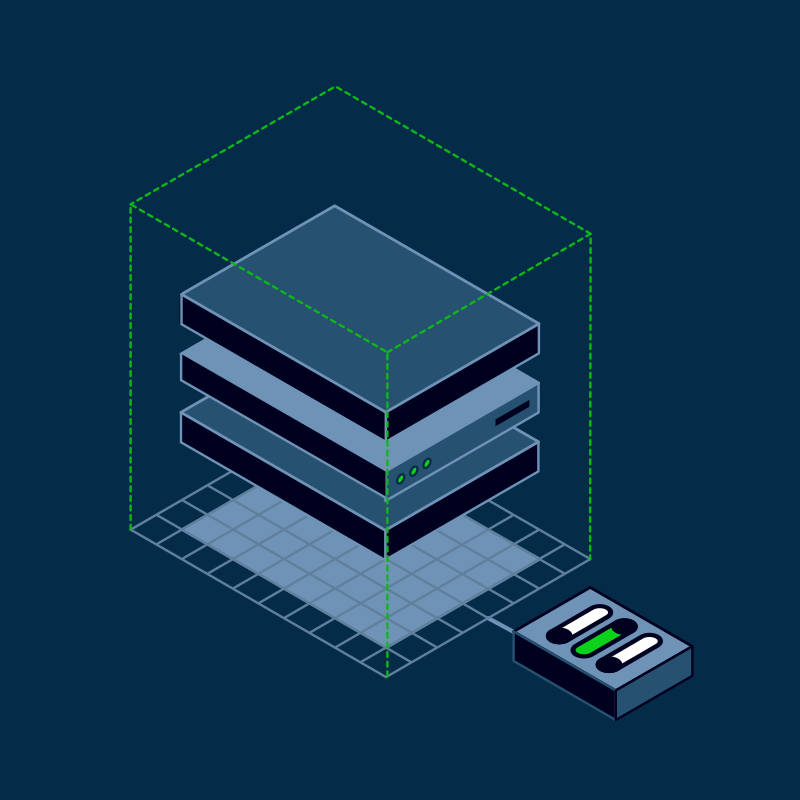
A true cloud deployment must be able to spin up additional resources, be they compute or storage, without effort or overhead. Similarly, those resources should "disappear" again when no longer needed, available for immediate consumption by other tenants or services.
To achieve this, HyperCloud nodes are stateless, instead pulling their configuration from the cluster at boot time, after which they immediately begin working. When a workload spins down, the node's resources are released and returned to the pool, awaiting its next service.
This ephemerality means that HyperCloud nodes are auto-configured, auto-maintained, and hot-swappable, ensuring effortless management. As a leading private-cloud provider, SoftIron ensures that HyperCloud offers unmatched efficiency and performance.
Atomic Peering
Cloud resources are intended to be easily consumed, not to demand extra administration or configuration overhead. If you build your cloud from a rat’s nest of generic servers and subsystems, it is burdened by layers of management and maintenance. Eventually, its complexity and fragility will cause failures, and you’ll have to stop everything to repair and reconfigure.
That is not a "solution."
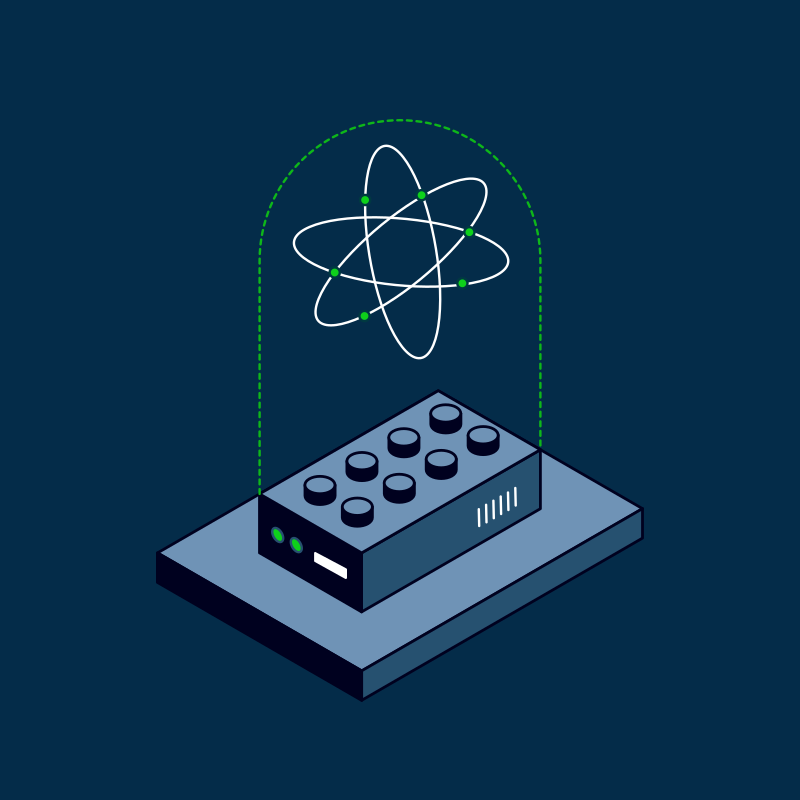
The foundation of SoftIron's HyperCloud is the atomic cloud peer (ACP). "Atomic" means that these units are the basic, immutable building blocks of the cloud. "Peer" means they are all peers; they all possess the critical capabilities allowing them to operate as a unified fleet, whether they are optimized for compute, storage, interconnect or any other task-specific function. This is the "cloud DNA" that enables SoftIron deployments to behave as a true private cloud.
Fleet Intelligence
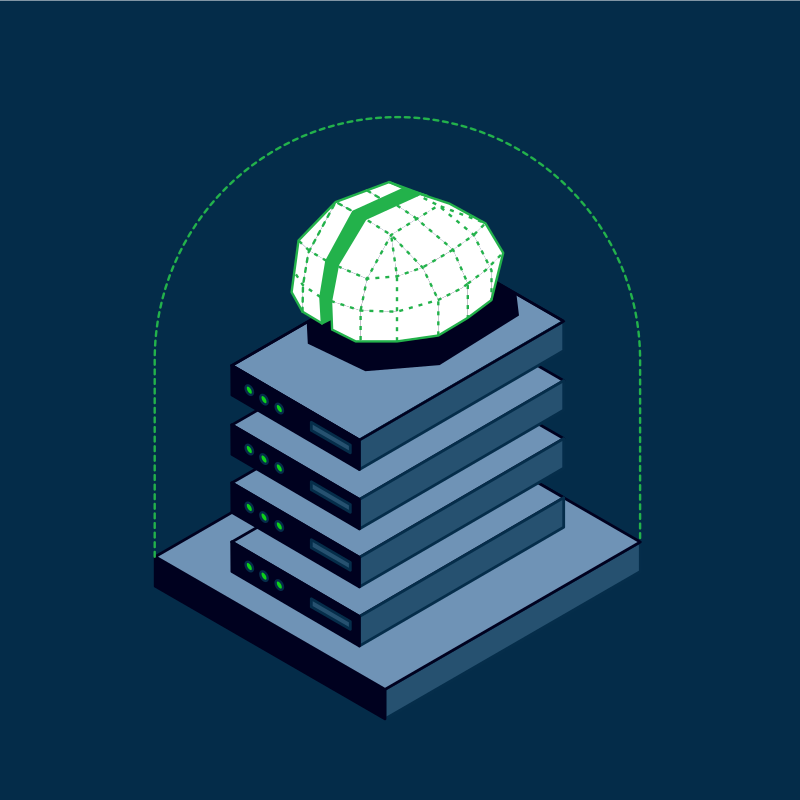
A true cloud is holographic; it distributes its management intelligence across all of its installed components, eliminating the need for a supervisor, and also eliminating choke points and single points of failure.
As new nodes appear, they are automatically assimilated and configured by the existing cluster. As a fleet sharing common hardware and software management capabilities, the cluster can detect problems, self-maintain, and self-heal. When an upgrade is required, a single update is applied to the cluster that updates all hardware and software autonomously and without service interruption.
Automatic Scaling
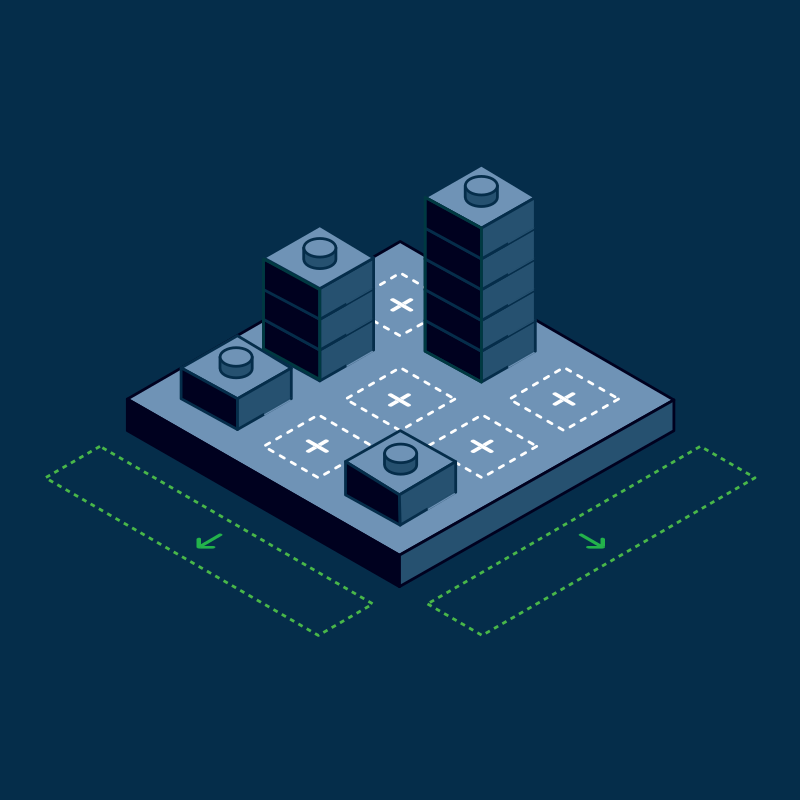
Like a swarm of bees in nature, fleet intelligence and resilience grow automatically as the cluster grows, incrementally adding redundancy and management resources with every node.
This ability to scale does not rely on any particular node type, allowing compute or storage resources to be added freely as the cloud grows, with no theoretical maximum. This ensures maximum resource availability and efficient consumption at all times.
Adding nodes is a simple operation, requiring nothing more than racking and stacking the hardware. Your staff thus remains entirely free from additional administrative chores.
HyperCloud: A True Cloud Experience
-
Build Like Cloud
As the most flexible expression of SingularIT's total-virtualization technology, the HyperCloud product suite allows organizations to build on-premises IT deployments that behave like a true private cloud, not like a legacy data center. Solving this problem required us to invent a totally new approach to storage, compute nodes, and interconnects.
The result is HyperCloud: a product that allows you to scale your cloud without conventional limitations or overhead. HyperCloud also supports hybrid topologies, and can be configured as a managed private cloud or a hosted private cloud, providing stable performance with advanced security.
-
Deploy Like Cloud
HyperCloud brings the ease and speed of cloud computing to your own premises. Configure and purchase your initial cloud deployment, rack the equipment, then sit back and let HyperCloud’s fleet intelligence do the rest.

-
Scale Like Cloud
HyperCloud allows you to expand your resources effortlessly and without limit as your demand grows.

-
Manage Like Cloud
Break free from the complexities and limitations of legacy IT deployments. HyperCloud handles resource orchestration for you, so you can spend less time managing your racks and more time managing your business.